



The Frontier Firm: Staying Ahead on the New Business Frontier
This article explains how “Frontier Firms” are pulling ahead by intentionally redesigning their operating models around software, AI, and digital labor—using technology to move faster, scale capacity, and turn constant change into a competitive advantage.

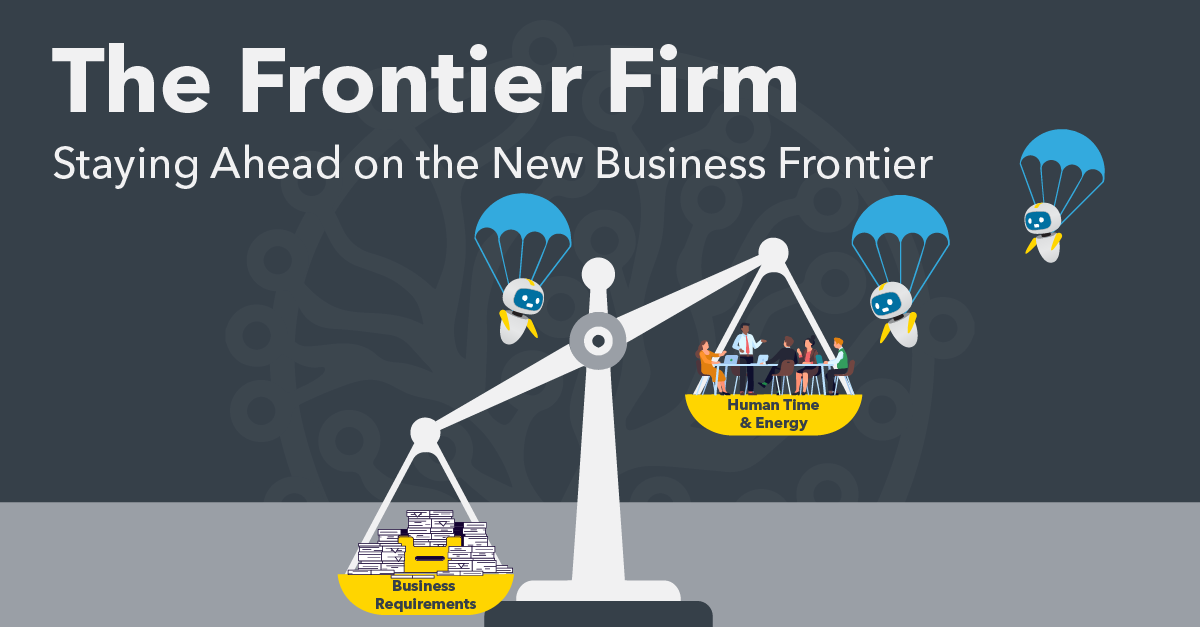
The frontier has shifted. Today, businesses are finding themselves operating in a new frontier shaped by software.
In this new environment, technology is fundamentally changing how work gets done, how quickly organizations can adapt, and how effectively they can compete. Put simply, software isn’t just part of the operation—it is the operation.
For many businesses, this shift has shed light on an uncomfortable truth: if you’re not embracing technology to modernize your operations, you’re losing ground to someone who is. Not because your competitors are smarter or bigger, but because they’ve learned how to move faster, do more with less, and turn change into an advantage.
This shift didn’t happen overnight. It happened incrementally, one system at a time, one workaround at a time, and one “temporary” solution that quietly became permanent. The result is a growing divide between organizations that are intentionally designing how technology drives their business, and those that are simply being pulled along by it.
The organizations pulling ahead now have a name. In its annual Work Trend Index report, Microsoft coined the term Frontier Firm to describe companies that are redefining what it means to operate, scale, and compete in a software-driven world.
In this article, we’ll take a closer look at how Frontier Firms are actually operating day-to-day and, more importantly, what they’re doing differently. Along the way, we’ll explore the patterns behind their success and outline practical steps you can take to unlock new levels of efficiency, adaptability, and capacity inside your own organization.
What is a Frontier Firm?
Despite the name, a Frontier Firm isn’t a fundamentally new type of company or limited to high-tech organizations. It simply describes a shift in how technology shows up in the day-to-day running of the business.
In Frontier Firms, technology is not looked at as a cost center. Instead, leaders are embracing emerging technology (especially AI) to reshape how work flows through the organization, how processes evolve, and how efficiently tasks move from start to finish. Software, data, and automation are treated as practical tools for getting work done, not abstract technology initiatives.
What sets Frontier Firms apart is not the size of their technology budgets or how cutting-edge their systems are. It's how intentionally they use technology to support people, expand capacity, and remove friction from everyday work.
Basic Terminology (In Plain English)
For Frontier Firms, widespread AI adoption is a key element of their operating strategy. More specifically, it’s been the rise of agentic AI—AI systems that can reason, plan, and take action—that's reshaping how work gets done. Frontier Firms aren't just using AI as a tool to assist individuals; they're harnessing the power of AI to redesign how teams operate.
To make sense of what this looks like in practice, it helps to level-set on a few basic terms. These concepts form the foundation of how Frontier Firms think about work, capacity, and collaboration between people and software.
Agent
An agent is an AI-powered system that can reason, plan, and take action to complete tasks or entire workflows. Agents can operate independently, but they do so with human oversight at key moments, especially when judgment, exceptions, or accountability matter.
Agent Boss
An agent boss is a human being who manages one or more agents. Instead of doing all the work themselves, they decide what to delegate, review results, and step in when needed. In Frontier Firms, managing agents is becoming a natural extension of many roles.
Intelligence Resources
Intelligence resources describe a new organizational function focused on managing digital labor. It blends elements of IT and HR, helping organizations decide where agents should be used, how they are governed, and how they support people across the business.
Human-Agent Ratio
The human-agent ratio focuses on balance. It reflects how many agents a person can reasonably oversee and where human involvement adds the most value. Getting this right helps organizations avoid both underutilizing AI and overwhelming their teams.
Work Chart
A Work Chart represents a shift away from traditional org charts. Instead of organizing around job titles or departments, work is organized around outcomes. Teams form around the work that needs to be done, supported by both people and agents.

Figure 1: Evolution of Org Charts to Work Charts
Bridging the Capacity Gap
At first glance, the rapid adoption of agentic AI can feel chaotic, as if organizations are experimenting in every direction at once. In reality, there’s a clear method behind the madness. Frontier Firms are adopting agentic AI with a specific goal in mind: addressing the growing gap between what the business needs to accomplish and what humans alone can realistically deliver.
This capacity gap shows up when demands continue to rise, but time, energy, and attention do not. Rather than pushing teams harder or endlessly adding headcount, Frontier Firms can leverage agentic AI as a deliberate way to expand capacity, rebalance workloads, and keep work moving without burning people out.
This gap is no longer theoretical. Data from the aforementioned study shows that 53% of leaders say productivity needs to increase, while 80% of the global workforce—leaders and employees alike—say they already lack enough time or energy to do their work. Expectations keep rising, but human capacity has its limits.

Figure 2: Statistics Showing Just How Real the Capacity Gap Actually Is
The result is a widening gap that shows up as burnout, bottlenecks, delays, and work that never quite gets finished. Frontier Firms acknowledge this reality head-on. Instead of trying to squeeze more out of already stretched teams, they look for ways to add capacity without throwing human capital resources at the problem(s).
Organizational Intelligence: Now on Demand
Digital labor is the term Frontier Firms use to describe AI or agents that can be brought in on demand to help close the capacity gap. Much like cloud computing made it possible to scale infrastructure without buying more servers, digital labor makes it possible to scale work itself. Tasks that once required hours of human effort can now be handled by software, freeing people to focus on judgment, creativity, and higher-value work.
Bridging the capacity gap is not about replacing people. It’s about recognizing that the pace of modern business has outgrown what humans can sustain on their own. Frontier Firms use digital labor to meet rising demands in a more balanced, sustainable way by expanding capacity where it’s needed while protecting the people creating real value.
AI Teamwork Makes the Dream Work
Closing the capacity gap isn’t about choosing between people and technology. Frontier Firms are discovering that the real progress happens when the two work together. AI isn’t replacing teams. It’s stepping in as a teammate, handling repetitive and time-consuming work so people can focus on judgment, collaboration, and higher-value decisions.
This shift is changing what “teamwork” looks like inside modern organizations. To understand how it works in practice, it helps to start with the newest member of the team.
A New Kind of Team Member
For most organizations, this kind of shift doesn’t happen all at once. Frontier Firms typically start by pairing employees with AI assistants (e.g., Microsoft Copilot) that help with everyday tasks like drafting, summarizing, researching, or handling routine requests. At this stage, AI supports individual productivity without changing how teams are structured.
Over time, that model evolves. As organizations become more comfortable with AI, assistants begin to take on more responsibility and operate as agents that handle entire tasks or workflows. Instead of helping one person at a time, agents support teams by managing repeatable, low-risk work in the background.

Figure 3: Phased Adoption of Agents in Frontier Firms
Eventually, this leads to true human-agent teams. Agents assume responsibility for many basic or repetitive tasks, while people focus more on judgment, collaboration, and higher-value work. The goal is not to replace workers, but to steadily free them from work that limits their ability to create real value.
This phased approach allows organizations to build confidence, establish oversight, and expand capacity gradually without disrupting how work gets done.
Managing Agent Teams
As agents take on more responsibility, managing them becomes part of everyday work. In Frontier Firms, this is less about technology and more about leadership. Teams set clear expectations, define boundaries, and decide when human judgment is required.
Done well, managing agent teams looks a lot like managing people. Leaders delegate work, review outcomes, and step in when exceptions arise. By treating agent management as a skill and keeping humans involved where it matters most, Frontier Firms are able to scale work while maintaining accountability and trust.
By the Numbers: Achieving More with Less
One of the most compelling aspects of AI agents is their role as a workforce multiplier. By taking on routine, repeatable work, agents enable organizations to increase output without increasing headcount. This allows teams to handle more demand, reduce bottlenecks, and improve responsiveness, all without putting additional strain on the people doing the work.
To make this concrete, consider a simple example. If a team spends 10 hours per week on a repetitive task and an AI agent can reliably handle 70% of that work, the organization effectively recovers 7 hours per week per employee. Multiply that across a team of 20 people, and you’re looking at 140 hours of capacity returned every week—without hiring anyone new. That reclaimed time can be redirected toward higher-value work, faster turnaround, or reduced backlog.
To go deeper on how to calculate these gains in a structured way, we’ve covered this in more detail in a previous article, Build the Business Case for AI Automation. That piece walks through the basic mathematical formulas needed to estimate potential cost savings and capacity gains on a case-by-case basis, helping leaders move from abstract benefits to defensible numbers.
How to Get Started
Becoming a Frontier Firm doesn’t require a massive transformation or a leap into the unknown. Most organizations make progress by taking a few deliberate, repeatable steps and building momentum over time.
- Choose the Right AI Platform for Your Business
Start by choosing an AI platform that fits naturally into how your organization already works. Whether you have a predilection for packages from Microsoft, OpenAI, or Anthropic, the point is to look for tools that integrate well with your existing systems, have strong security and governance capabilities, support agent-based workflows, and allow you to start small without heavy upfront investment. The goal is to create a foundation you can build on, not lock yourself into something rigid. While this is not a decision to be made lightly, it's equally important to not get sucked into an analysis paralysis loop. - Document Your Processes
Before introducing agents, take time to clearly document how work gets done today. Identify repeatable tasks, decision points, and handoffs. This doesn’t need to be perfect, but having a shared understanding of your processes makes it much easier to decide what can be delegated to digital labor and where human judgment is still required. - Make Time for Experimentation
Frontier Firms treat experimentation as part of the job, not a side project. Set aside time for teams to test small use cases, try new workflows, and learn what works. Start with low-risk, high-friction tasks where even small gains can free up meaningful capacity. - Measure Results
Track the impact of your efforts early and often. Measure reclaimed time, reduced backlog, faster cycle times, or improved consistency. Clear metrics help build confidence, guide next steps, and make the value of AI adoption visible to leadership. - Lather, Rinse, Repeat
Progress comes from repetition. Use what you learn to refine your approach, expand to new areas, and continuously improve how humans and agents work together. Frontier Firms don’t treat AI adoption as a one-time initiative, but as an ongoing capability they continue to evolve.
Becoming a Frontier Firm is not about getting everything right the first time. The organizations that see the most value from AI are the ones that treat adoption as an ongoing process of learning, testing, and refining. Small experiments, repeated often, create clarity about where AI adds real value and where human involvement remains essential.
Just as important, Frontier Firms look beyond one-off productivity gains and focus on using AI to continuously improve how work gets done. By steadily expanding what agents can handle and adjusting how teams collaborate with them, these organizations unlock more capacity over time. The result is not just short-term efficiency, but a more adaptable, resilient way of operating that keeps pace with changing business demands.
Closing Thoughts
The idea of the Frontier Firm reflects a shift many organizations are already beginning to navigate. As software and AI become more integrated into everyday work, there is a growing opportunity to rethink how work gets done and where people can focus their time. Frontier Firms approach this shift with intention, using technology to expand capacity, reduce friction, and better support the people creating value across the business.
For most organizations, progress toward this model is steady and practical rather than dramatic. By experimenting thoughtfully, measuring results, and refining how humans and digital labor work together, teams can continue to improve efficiency and adaptability over time. With the right mindset, this approach offers a realistic path to building organizations that are better equipped to keep pace with change while remaining sustainable and people-centered.