


When Your ERP Support Clock Hits Zero: Now What?
This article explains that when ERP systems reach end-of-support deadlines, organizations shouldn’t rush into costly upgrades out of fear but instead take a deliberate, strategy-driven approach—evaluating options and aligning next steps with real business needs rather than vendor pressure.

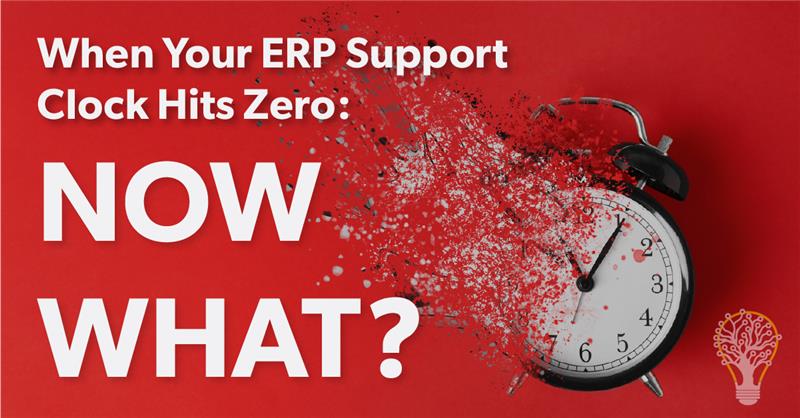
At some point, every ERP system reaches an uncomfortable milestone: the support clock hits zero. Suddenly, the system that has been quietly powering day-to-day operations shoots to the top of the executive team’s issue list. Not because it stopped working, but because of the perceived risk of failure has been dialed up to an 11 by ERP vendors using urgency and fear to accelerate expensive upgrade decisions.
If you've been running ERP systems for a while, you've no doubt been here before. Still, end-of-support milestones often trigger fear-driven narratives that make delay feel irresponsible, even when operations remain stable. The reality is far more measured. This is a common point in the ERP lifecycle, not an emergency. The real risk is not taking time to decide. It's rushing into a costly decision driven by anxiety rather than business need.
In this article, we’ll take a step back and slow the conversation down. We’ll explore what end-of-support actually means, why “upgrade now” is not the only responsible option, and how your organization can successfully keep the lights on while you figure out what comes next. The goal isn’t to avoid modernization, but to approach it deliberately with a clear business case and a strategy that reflects how your organization actually operates today.
Because when the ERP support clock hits zero, the smartest move isn’t to panic. It’s to pause, assess, and choose your next step with intention.
Two Clocks, Two Outcomes: End of Support vs. End of Life
Not all ERP deadlines are created equal. One of the most common questions we hear from customers is the difference between “end of support” and “end of life.” While the terms are often used interchangeably, they represent very different scenarios with distinct implications for risk, urgency, and planning.
Over the past decade, the ERP landscape has been reshaped by cloud computing and, more recently, AI. Those shifts have created significant disruption in how ERP software is built, sold, and monetized. As a result, ERP vendors have been aggressively consolidating product portfolios through acquisitions, repositioning platforms as SaaS offerings, and in some cases retiring long-standing on-premises products altogether. That backdrop matters, because it explains why some systems are merely aging while others are being intentionally sunset:
- End of Support typically means the vendor has stopped delivering standard updates, fixes, or enhancements for a specific version of a product. The software doesn’t suddenly stop working. Many organizations continue to run these systems successfully for years with the right safeguards in place. While there are legitimate considerations around security, compliance, and supportability, the clock here is more forgiving. You have time to evaluate options, stabilize the environment, and build a business case for what comes next.
- End of Life, on the other hand, is a different clock entirely. This is when a vendor either exits the market or makes a strategic decision to discontinue a product altogether, often in favor of a newer, cloud-first platform. A clear example is Microsoft Dynamics GP, which Microsoft has officially decided to retire as it shifts customers toward Dynamics 365 Business Central. In these cases, while it may still be possible to maintain the status quo for a period of time, the runway is shorter and the long-term viability of staying put diminishes more quickly. Skills become harder to find, integrations stagnate, and strategic alignment with the vendor roadmap effectively ends.
These distinctions matter. In both scenarios, organizations often have ways to keep systems running safely in the near term. But when the product itself is at end of life, the urgency to define a forward-looking strategy is much higher. Ignoring that reality can leave you reacting later under far less favorable conditions.
Regardless of which camp you find yourself in, one step is unavoidable and beneficial: exploring your upgrade and transition paths early. Even if you decide not to move immediately, understanding the scope, cost, and business impact of your options puts you back in control of the timeline.
A Business Decision Disguised as a Technology Problem
On the surface, ERP upgrades feel like a technology problem. However, given how complex these projects tend to be, that framing only tells part of the story. ERP systems are woven into the fabric of the business, influencing how work gets done across finance, operations, supply chain, and beyond. Changing them isn’t just a software exercise. It affects processes, people, and routines that have often been in place for years.

Figure 1: ERP Upgrade Projects are More of a Business Problem Than a Tech Problem
When you look at it that way, the real question shifts quickly. It’s not “What version should we be on?” It’s how much change the business is actually ready to absorb, and what that change will cost in time, focus, and disruption.
ERP systems sit at the center of how organizations operate. They shape processes, data flows, reporting, and day-to-day execution across finance, supply chain, manufacturing, customer service, and more. Changing that foundation isn’t just a technical exercise. It affects people, workflows, controls, and institutional knowledge that has accumulated over years, sometimes decades. Treating an ERP decision as “just an upgrade” is how organizations end up underestimating both the effort and the impact of the project.
The Panic Trap: Why "Upgrade Now" Isn't Always the Best Move
When ERP support deadlines loom, it’s easy to feel like there’s only one responsible move: upgrade as quickly as possible. Vendor roadmaps are all too eager to reinforce that urgency, often framing newer versions as the obvious next step for your business. The catch is that those roadmaps are designed to optimize the vendor’s product strategy, not necessarily the realities of your business. That doesn’t make them wrong, but it does mean they shouldn’t be the only input driving your decision.
This is where organizations can fall into the panic trap. The pressure to act is real, but rushing into a major ERP upgrade carries its own set of risks. These programs demand executive attention, cross-functional alignment, and sustained focus long after the software goes live. They disrupt day-to-day operations, stretch your internal teams thin, and introduce change fatigue across the organization. Just as importantly, they consume capital and talent that might otherwise be invested in initiatives more directly tied to business growth or differentiation. Those tradeoffs rarely show up in vendor presentations, but they matter deeply to the business.

Figure 2: When Vendor Urgency Turns Long-Term Planning into a Bomb Disposal Exercise
To be clear, this isn’t an argument against modernization. Newer ERP platforms absolutely offer meaningful improvements in areas like usability, analytics, integration, and increasingly, AI-driven capabilities. For some organizations, those benefits clearly justify the investment. For many others, however, the incremental gains don’t immediately outweigh the full cost, disruption, and risk of a large-scale upgrade done under pressure.
The key takeaway is simple: faster decisions are not always better decisions. When fear frames the conversation purely in technical terms, it’s easy to overlook operational risk, change fatigue, and opportunity cost. In many cases, maintaining stability while you evaluate options, build a defensible business case, and align leadership is the more responsible move. ERP end-of-support isn’t really about what you upgrade to. It’s about when, why, and how you do it, on your terms rather than someone else’s timeline.
Keeping the Lights on While You Figure Out What's Next
One of the biggest misconceptions around ERP end-of-support is that your only choices are to upgrade immediately or accept unacceptable risk. In reality, many organizations choose a third path: stabilizing the environment while they take the time to plan what comes next.
Today, there’s a mature ecosystem of aftermarket support providers that specialize in exactly this scenario. A prominent example is Rimini Street, which provides full-service support for a wide range of ERP platforms after OEM support ends. These services typically include routine system maintenance, monitoring, break-fix support, patching, and security coverage. For many organizations, the level of support is comparable to, and in some cases more responsive than, what they received directly from the software vendor.
In addition to full-service providers, there are also co-managed service options including our very own Lighthouse service here at Bowdark. These co-managed options strike a balance between stability and forward progress by pairing day-to-day operational support with strategic advisory services. Rather than handing everything off to a third party, you can retain ownership and institutional knowledge while gaining access to specialized resources with deep experience in ERP upgrades, integrations, data, and modernization initiatives.

This model is especially effective during periods of transition. Co-managed teams can help guide upgrade or migration efforts when the time is right, while simultaneously driving incremental improvements around reporting, automation, and process optimization in the meantime. The result is a more controlled path forward—one that keeps critical systems running, reduces risk, and ensures innovation continues even as larger decisions are being evaluated.
Navigating Security and Compliance Risks
Security is often the biggest concern when support ends, and it’s an area where aftermarket providers have invested heavily. Rimini Street, for example, offers proactive security solutions designed to reduce risk exposure in an increasingly complex threat landscape. Without relying on vendor-issued patches, their approach focuses on improving overall security posture to help protect databases, applications, and surrounding infrastructure. Through offerings like Rimini Protect, you can gain zero-day protection against entire classes of vulnerabilities, addressing risks before they can be exploited rather than reacting after the fact.
(Re)Balancing Your Support Budget
Another often-overlooked benefit of aftermarket support is what it unlocks in terms of cost savings. Because aftermarket support is typically far less expensive than traditional vendor maintenance, many organizations find themselves with meaningful budget headroom almost immediately. Instead of pouring those dollars into keeping the lights on—or rushing into a costly, multi-year upgrade—those savings can be redirected toward initiatives that deliver value to the business now.
For some organizations, this changes the conversation entirely. Rather than freezing development for 12–24 months while a complex upgrade project grinds forward, you can reallocate those funds towards targeted initiatives that directly benefit users now: better reporting, process automation, integrations with modern SaaS tools, or user experience enhancements that reduce friction in day-to-day work. The ERP stays stable, but the business doesn’t have to stand still.
The tradeoff, of course, is that core ERP functionality is effectively frozen in time from a vendor roadmap perspective. You won’t see new modules or major feature releases. But “frozen” doesn’t have to mean stagnant. With modern integration platforms, cloud services, and carefully scoped extensions, organizations can safely innovate around the edges while keeping the ERP core secure and reliable.
In practice, this approach protects what’s working today while creating space to invest in what’s needed next. It allows teams to move forward on a timeline driven by business priorities, turning support savings into a catalyst for near-term innovation rather than a pause button on progress.
Buying Time to Think
Depending on how old your legacy system is, it's worth noting that the upgrade path could be quite long and arduous. For example, many of our SAP customers that are looking to take their ERP workloads to the cloud are looking at the upgrade path shown in Figure 3 and wondering if a greenfield re-implementation might end up being easier. This is a huge decision where most customers benefit greatly from having more time to thoroughly evaluate their options.

Figure 3: The Long Road to Innovation with SAP S/4 HANA
Reassessing Fit-for-Purpose
One of the most valuable things an ERP end-of-support moment can give you is permission to pause and reassess. If you're like most organizations, the ERP you’re running today may have been selected years (even decades) ago based on a very different version of the business. Since then, your operations have evolved, markets have shifted, and differentiation may now live in places the original system was never designed to support. Still, the ERP remains largely unquestioned, more out of familiarity than actual fit.
The reality is that no ERP vendor is great at everything. Most platforms excel in a few core areas. For example, most commercial ERP packages are strong up the middle in terms of core modules like finance or inventory management. However, they usually fall short in other areas. Moreover, a lot of the industry specialization that was built up in the late 1990s/early 2000s has gotten lost in the shuffle as ERP vendors have shifted their focus towards cloud/SaaS migrations. The old promise of a single system that does it all has largely proven to be one-size-fits-most, and even that’s being generous.

Figure 4: One-size-fits-all. Results may vary by department…wildly.
That's why end-of-support can be a healthy forcing function. It creates a natural moment to step back and ask some of the harder questions:
- Does this system reflect how we actually operate today, or how we used to operate?
- Where does our business truly differentiate—and does our ERP help or hinder that?
- Which process gaps have we quietly worked around for years?
- Are industry-specific requirements being met, or merely tolerated?
- How much integration glue have we added just to make things usable?
Too often, organizations are conned by ERP vendors into thinking that upgrading what they have is synonymous with improvement. In practice, most ERP upgrade projects modernize the technology stack without addressing underlying business process issues. As a result, the same misaligned processes, awkward workflows, and functional gaps simply get carried forward—now with a higher price tag and a fresh implementation.
A thoughtful fit-for-purpose assessment flips that script. Rather than assuming the ERP is the center of everything, it evaluates how well the system supports the business as it exists today—and where it should step out of the way. That means doing real fit/gap analysis, understanding which capabilities truly belong in the ERP core, and where complementary systems or extensions make more sense.
As part of reassessing fit-for-purpose, many organizations are also turning to process mining tools such as Microsoft Power Automate and SAP Signavio to move beyond assumptions and anecdotes. These tools deeply analyze real system event data to visualize how processes actually run end to end, highlighting variations, inefficiencies, and bottlenecks that may not be obvious on paper. When used alongside a gap/fit analysis, process mining provides objective insight into where processes are breaking down, where workarounds are creeping in, and which areas should be prioritized for improvement. This is just another tool in the toolbelt to help you focus modernization efforts on the changes that will deliver the greatest operational impact.

Figure 5: Process Mining with Power Automate
Composable ERP: It's All About Choice
For years, the idea of building an ERP environment from best-of-breed systems was largely dismissed as a non-starter. The reasons were understandable at the time: high integration complexity, brittle point-to-point connections, and a perceived spike in total cost of ownership. In that world, a tightly coupled, monolithic ERP built on a single database was seen as a strength. One vendor. One data model. One throat to choke. Simplicity, even if it came with tradeoffs, just felt safer.
Fast forward to today, and those assumptions no longer hold. Advances in cloud platforms, modern integration tooling, APIs, and microservices have dramatically reduced the friction that once made best-of-breed strategies risky. Systems are designed to interoperate. Data can move in near real time. Integrations are more resilient, observable, and easier to evolve over time. What was once complex and fragile has become far more manageable, and in many cases, preferable.
Recognizing this shift, Gartner introduced the term composable ERP several years ago to better describe this new reality. In plain language, composable ERP means you’re no longer forced to get everything from one vendor. Instead of relying on a single monolithic system to handle every business function equally well, organizations can intentionally assemble the capabilities they need—finance, supply chain, HR, analytics, automation—using a mix of core ERP functionality and best-fit complementary systems. The ERP remains important, but it’s no longer required to be the answer to every problem.

Figure 6: Evolution Towards Composable ERP
What makes this approach viable today is modern integration platforms. APIs, event-driven architectures, cloud platforms, and low-code tools have dramatically reduced the risk and complexity that once came with best-of-breed strategies. Integrations that used to require brittle custom code can now be implemented in a more standardized, observable, and maintainable way. As a result, we can effectively decouple change from disruption.
Composable ERP Isn't as Radical as It Sounds
It’s worth acknowledging the reality of today’s ERP ecosystems. After a period of heavy M&A activity, even the so-called “single-vendor” ERPs most organizations run today are already collections of acquired products stitched together over time. Finance comes from one lineage, HR from another, and planning from a third. Composable ERP simply makes that reality explicit—and puts control back in the hands of the business.

Figure 7: These Days, It's Mostly All Composable ERP Anyway
Why Shopping Around Isn't a Bad Idea
One of the most overlooked benefits of a composable ERP approach is the freedom to choose tools that actually fit how each department operates day to day. Finance, HR, supply chain, procurement, and operations don’t work the same way, so they shouldn’t be forced into the same constraints simply for the sake of platform uniformity.
Taking the time to evaluate options at the functional level can have an outsized impact. The right solution can reduce manual work, simplify workflows, and give teams tools that align with how they actually get things done. Small improvements in usability or automation often translate into meaningful productivity gains when applied to daily tasks.
Composable ERP makes this possible by decoupling departmental decisions from enterprise-wide upheaval. Instead of settling for “good enough” across the board, you can be intentional about where specialization matters most, striking a balance between creating better experiences for the people using the systems every day, while still maintaining cohesion at the enterprise level.
Innovating Around the Edges
Composable ERP doesn’t just change how systems are assembled, it changes where the innovation happens. Rather than waiting for vendors to deliver specific features or applying surgical enhancements deep inside the ERP core, modern organizations are increasingly innovating around the edges using cloud-based low-code development platforms (LCDPs), where change is faster, risk is lower, and business impact is more immediate.
LCDPs allow organizations to layer new capabilities on top of existing ERP systems without waiting for a full upgrade or replacement to be completed. For example:
- Advanced analytics can be introduced by unifying ERP data with operational, customer, or external data sources to deliver real-time dashboards, exception reporting, and predictive insights without reworking ERP reporting modules.
- Process automation can streamline cross-system workflows like order-to-cash, procure-to-pay, or onboarding, eliminating manual handoffs and spreadsheet-driven workarounds that live outside the ERP today.
- AI-powered agents can assist users with tasks such as answering questions about orders or inventory, flagging anomalies, recommending actions, or guiding employees through complex processes without changing how transactions are recorded in the core system.
- User experience improvements can be delivered through lightweight apps or portals that simplify data entry, approvals, and task management, especially for frontline or occasional users who don’t need full ERP access.
- Targeted extensions can address functional gaps—including industry-specific gaps—by integrating specialized tools where the ERP falls short. In most cases, this is highly preferrable to forcing a one-size-fits-all module to stretch beyond its predefined limits.

Figure 8: Streamlining Field Operations with a Custom AI-Powered Agent
This model creates a far more pragmatic path to transformation. Instead of freezing innovation for 12–24 months while a large-scale ERP program runs its course, teams can deliver incremental improvements that matter now. Each initiative is scoped, measurable, and aligned to a specific business outcome.
Innovating around the edges turns ERP modernization from a single, high-stakes event into a continuous, business-driven process—one that improves how the organization operates today while preserving flexibility for whatever comes next.
Building Your Roadmap
Modernization doesn’t have to be rushed to be effective. In fact, the most successful roadmaps are the ones that create forward momentum without forcing the organization into decisions it isn’t ready—or funded—to make. The goal is to help you innovate at a pace that feels comfortable, sustainable, and affordable, while keeping your options open.
Short Term Initiatives: Stability & Clarity
The first phase of any roadmap should focus on protecting the business you have today.
Start by clearly defining what must continue to run without disruption. Not every system needs to be modernized immediately, but every critical process needs to be understood. From there, address the areas that create the most near-term risk—security gaps, compliance exposure, fragile integrations, or support models that rely on tribal knowledge.
In many cases, this phase is about buying time deliberately. That might mean stabilizing a legacy system, improving monitoring and support, or leveraging alternative support models to reduce risk and cost. The key is intentionality: buying time as part of a plan, not as an indefinite delay.
Long-Term Initiatives: Optionality & ROI
With stability established, the roadmap can shift toward optionality and value creation.
Rather than letting vendor timelines dictate your strategy, establish clear decision criteria rooted in your business. Every modernization decision should be evaluated through a practical lens that includes total cost, risk reduction, operational impact, and—often overlooked—strategic flexibility. The best path forward is rarely the one that replaces the most software the fastest; it’s the one that unlocks measurable business value while preserving choice.
Modernization should also be sequenced around business outcomes, not software modules. Focus first on the areas where change will improve efficiency, reduce friction, or enable growth. Over time, this creates a compounding effect where each step forward makes the next decision clearer and more informed.
Striking the Right Balance
The goal of a roadmap isn’t perfection. It’s informed, flexible decision-making—one that balances risk, cost, and opportunity while respecting how your organization actually operates. When done well, your roadmap becomes less about a single “big move” and more about creating the conditions to evolve confidently over time.
Closing Thoughts
ERP end-of-support is often framed as a forcing function, but it doesn’t dictate a single path forward. Organizations that take time to pause, assess their options, and plan deliberately tend to make better decisions—and better decisions compound. They spend less by avoiding unnecessary scope, disrupt the business less by sequencing change intelligently, and ultimately extract more value over time by aligning technology decisions with real operational needs rather than external pressure.
The best next step is rarely the loudest one or the most aggressively marketed. Progress doesn’t require panic, but it does require intention. When organizations move forward with clarity and purpose, modernization becomes a controlled evolution instead of a reactive scramble. Panic is optional. Intentionality is not.