


Before You Buy Another AI Tool, Download Your Team's Tribal Knowledge
This article argues that AI tools like copilots and agents are only as effective as the process knowledge behind them, and that investing in clear, up-to-date documentation and playbooks is essential to give AI the context it needs to deliver consistent, meaningful results.

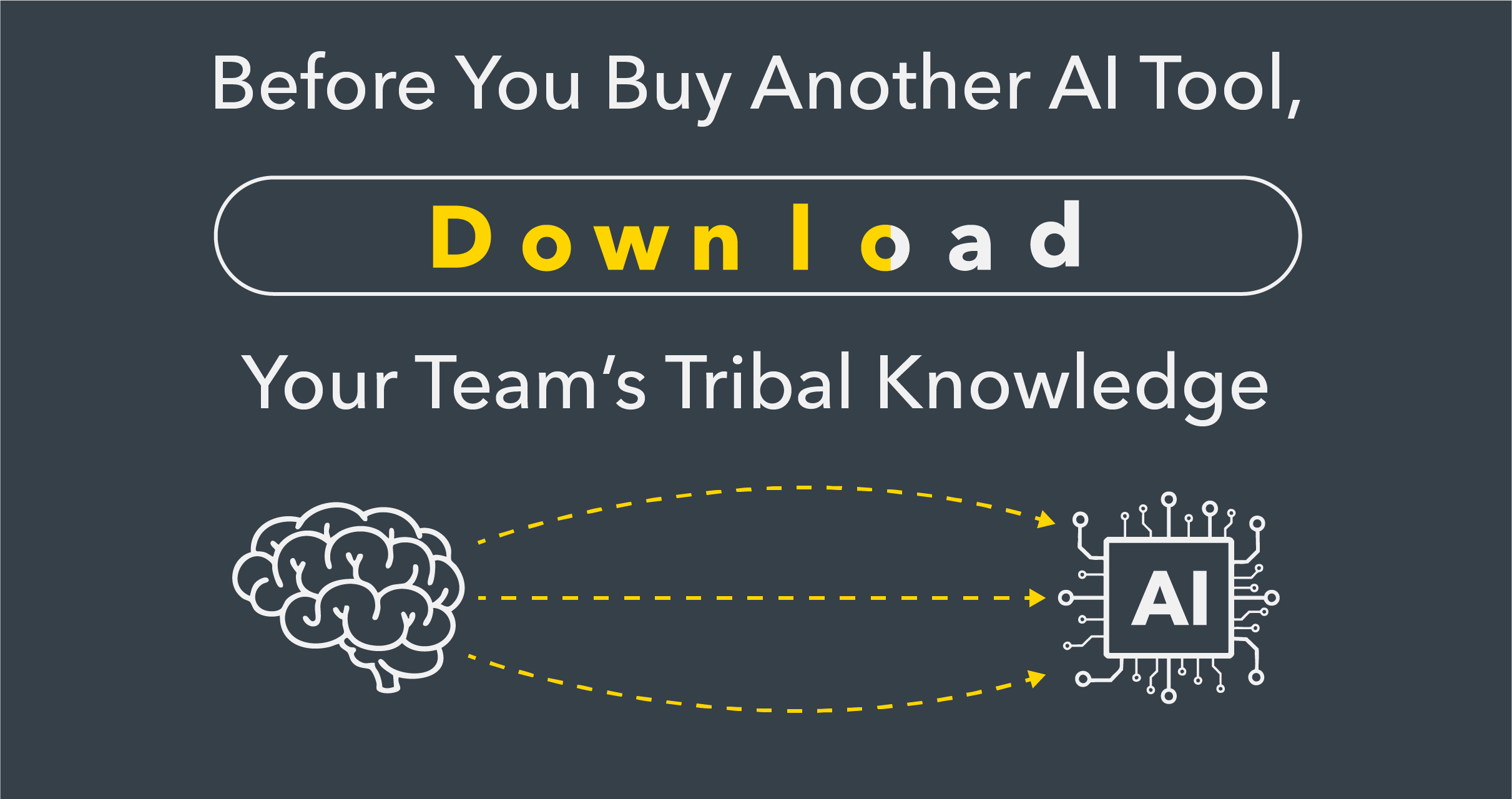
Organizations everywhere are in the midst of an AI spending spree. Copilots are being deployed, agents are being piloted, and automation platforms are securing budget approvals faster than just about any software investment in recent memory. The excitement is real, the investment is significant, and expectations are high.
However, despite all this momentum, MIT recently published a sobering study indicating that as many as 95% of generative AI pilots at companies are failing (Fortune, 2025). In our view, this statistic isn’t a referendum on AI's potential; it's a reflection of operational readiness (or lack thereof).
More often than not, we see these kinds of initiatives struggle because organizations attempt to layer intelligent tools onto poorly documented business processes that are inconsistent, undocumented, or loosely defined. And when workflows vary from person to person and critical decision logic lives in informal conversations or inbox threads, even the most advanced AI systems lack the clarity and structure they need to perform effectively.
This brings us to an important realization: AI doesn’t create operational clarity. It consumes it.
AI tools and intelligent agents are powered by large language models (LLMs). These models are remarkably capable, but they do not invent structure where none exists. They perform best when they're given clear instructions written in natural language, well-defined processes, explicit rules and decision paths, and meaningful context about systems, handoffs, and workflows. In short, they need to understand how your business actually operates.
When approval logic lives in inbox threads, exception handling is passed along in side conversations, and the “real” process resides in the minds of a few experienced employees, AI has nothing solid to stand on. Instead of executing with confidence, it's forced to infer, approximate, and guess. And guessing isn't a scalable operating model.
In this article, we’ll make the case that one of the most strategic moves you can make before investing in another AI tool is to update your playbooks. We’ll explore why modern AI agents depend on clear, documented processes, how to accelerate documentation without slowing the business down, and how turning institutional knowledge into structured guidance lays the foundation for scalable digital labor.
AI Doesn't Just Need Data — It Needs Context
LLMs are incredibly powerful. They can summarize, reason, draft, classify, and even make recommendations with impressive fluency. But they aren’t mind readers. And they don’t intuit how your business operates simply because you’ve connected them to a data source.

Figure 1: Hooking Agents Up to Raw Data Sources Isn't Enough
AI doesn’t automatically “know” your approval workflows. It doesn’t understand your escalation paths. It has no built-in awareness of your exception handling rules, your system handoffs, your naming conventions, or the tribal shortcuts your team relies on to get work across the finish line.
Those things feel obvious to your people because they’ve lived them. To an AI system, they are invisible unless they are explicitly defined.
When processes aren’t documented, AI is forced to infer what should happen next. It doesn’t know what action to take. It doesn’t know which system to interact with. It doesn’t know what “good” looks like in the context of your organization. And it certainly doesn’t know when a situation warrants escalation versus standard handling.
The result isn’t intelligence at scale. It’s ambiguity at scale.
This is why process documentation matters so much in the age of AI. They provide the context that transforms raw data into executable instruction. Without that context, even the most advanced models are operating in the dark.
After all, you can’t automate what you haven’t defined.
Tribal Knowledge Doesn't Scale
Most organizations don’t run purely on documented processes. In practice, they probably run on experience and a mix of:
- Shadow processes that never made it into official standard operating procedures (SOPs)
- Informal Slack or Microsoft Teams messages that (repeatedly) clarify “how we actually do it”
- Unwritten escalation paths passed along through conversation
- Familiar refrains like: “Ask Leslie — she knows how this works.”
If any of this reminds you of your organization, rest assured that you're in good company. We see companies of all sizes struggle here. And, to be fair, this model can work for a while. In fact, it can function indefinitely so long as:
- The team is small and tightly aligned
- Tenure is high and turnover is low
- Workflows are relatively stable
- The same individuals consistently handle the same responsibilities
However, at some point in in the future, it will inevitably begin to break down under pressure. This is especially true when:
- A key employee retires or leaves
- The organization scales or expands (e.g., through a merger or acquisition)
- New hires need to ramp up quickly
- Leadership pushes for standardization across business units
The model also breaks down as AI agents are introduced into the workflow. Since AI models don't have access to hallway conversations, they can’t interpret nuance buried in message threads or benefit from years of accumulated intuition. If the “real” process lives in people’s heads or in scattered collaboration tools, the system has nothing durable to operate from.
In that sense, AI doesn’t create ambiguity — it exposes it.
When you begin deploying agents, you’re forced to answer questions that may have previously been handled informally:
- What is the exact approval path?
- What qualifies as an exception?
- When should something be escalated?
- Which system is the source of truth?
What once felt flexible now requires definition. This isn’t a flaw in AI. It’s a reflection of operational maturity. And for organizations willing to embrace the discipline, it becomes an opportunity to convert tribal knowledge into institutional capability that truly scales.
The Unsexy Truth: Documentation is Strategic Again
Let’s be honest. Updating SOPs isn't glamorous work. It’s tedious and boring. So much so that it’s often the first thing to get deprioritized when something “more urgent” shows up. Customer requests, production issues, internal fire drills, last-minute executive asks — all of them feel more pressing, more visible, and more immediately valuable. In fact, those interruptions can even feel welcome because they provide a perfectly reasonable excuse to push documentation to the back burner. The work that would create long-term clarity is repeatedly postponed in favor of the work that demands immediate attention.
But in the age of AI, process documentation is no longer administrative overhead. In fact, you should think of it as infrastructure.

Figure 2: Updating Playbooks Might Not Be Fun, But It's Necessary
Think of it this way: your SOPs are the training manuals for digital labor force. Your playbooks serve as the instruction sets that guide AI agents, and your process manuals provide the execution logic that determines what happens next. When you introduce AI into the organization, you're not simply deploying software. You're onboarding a new kind of team member. And like any new hire, it won't perform effectively without clear guidance, defined expectations, and structured training. Bottom line: if you want AI to operate like a capable contributor, you have to train it like one.
Document Smarter, Not Harder
If the prospect of updating your playbooks feels overwhelming, you’re not alone. For most organizations, this sounds like a long, painful side project that slows everything down. That’s exactly why it keeps getting postponed.
The good news is that capturing process clarity in the age of AI doesn’t require locking your team in a room to write perfect SOPs from scratch. Modern AI-powered tools allow you to capture workflows as they happen through screen recordings, meeting summaries, and structured interviews. With a little bit of discipline, we can turn everyday tasks into structured guidance.
For team members that might groan about bureaucracy and red tape, it's important that we help them see the method to the madness. After all, if we do this right, agents have the ability to free up many hours in the day for higher value tasks. Yes, documenting processes can feel like an “eat your vegetables” moment and it does require some discipline and short-term discomfort. But that investment is what unlocks the fun part: the automation, the scale, and the ability to spend less time on repetitive execution and more time on work that actually moves the business forward.
Working with Process Documentation Tools
One of the biggest myths about process documentation is that someone has to sit down and painstakingly think through and write down every step from scratch.
The good news is that you don’t have to work that way anymore. Tools like Scribe and Tango can automatically capture a workflow while someone is performing it, turning clicks and actions into clean, step-by-step guides with screenshots. Instead of trying to remember how something works, you simply document it by doing it.
And if a process involves nuance or judgment calls, tools like Loom make it easy to record a quick walkthrough where a subject matter expert explains what’s happening and why. That recording can then be transcribed and shaped into a formal SOP. It’s faster, more natural, and far more likely to get done than the old “blank document and good luck” approach.
The Digital Ouroboros: Using AI to Train AI
Not every process can be captured through screen recording alone. Some of the most valuable operational knowledge lives in the judgment calls, edge cases, and “here’s how we really handle it” conversations that experienced team members carry in their heads. That’s where structured user interviews come in.
Tools like Microsoft Teams and Zoom make this easier than ever. You can schedule focused interviews with subject matter experts, record the session, and use built-in AI transcription features to generate a searchable transcript automatically. Instead of relying on handwritten notes, you walk away with a detailed, time-stamped record of how the process actually works.

Figure 3: Capturing Meeting Transcripts Using Microsoft Teams
From there, tools like Microsoft Copilot, ChatGPT, or Claude can transform those transcripts into structured SOP drafts. You can prompt the model to extract step-by-step workflows, identify decision points, summarize escalation paths, and even highlight exceptions. What might have taken days to write manually can often be converted into a clean first draft in minutes.
This technique can even work with older audio or video recordings where transcripts weren't originally captured. Using AI-powered services like Azure Speech, we can help you go through your digital archives and generate transcripts that you can use to kickstart your documentation efforts.
The key is to treat interviews not as informal conversations, but as structured knowledge capture sessions. With the right prompts and tools, you can capture and convert institutional expertise into documented, reusable, AI-ready process guidance.
Putting Your Playbooks to Work with Agents
Once your processes are documented, the real payoff begins. Playbooks stop being static documents sitting in SharePoint and start becoming instruction sets that power intelligent agents.
When workflows, decision rules, and escalation paths are clearly defined, agents can:
- Route approvals based on documented thresholds
- Validate inputs against established business rules
- Trigger actions across connected systems
- Surface next-best actions based on your defined process
- Escalate exceptions exactly as outlined in your SOP
Instead of asking employees to constantly reference manuals, agents can guide execution in real time. They can answer “what should happen next?” inside the flow of work. They can reduce variation by enforcing consistent steps. And they can operate 24/7 without adding headcount.
To put these concepts into perspective, consider the agent shown in Figure 4 below. This real-world agent is something we developed internally at Bowdark to help our consultants get answers to a wide array of operational and policy-related questions. It taps into documented playbooks, onboarding guides, benefits documentation, internal standards, and system procedures to provide fast, consistent answers without requiring someone to track down the “right person” every time.

Figure 4: Building Knowledge Agents
But it doesn’t stop at answering questions. Because those knowledge resources are structured and connected to workflows, we’re also using them to automate routine tasks. The same documented processes that explain how to onboard a new team member can now trigger the actual onboarding workflow to provision accounts, assign training, and notify stakeholders. Time-off requests can be guided and routed automatically based on documented approval paths. Expense submissions can be validated against policy rules before they ever reach finance.
In other words, agents don't just use documentation to provide regurgitated answers, they also use it to facilitate process execution. What started as captured institutional knowledge becomes the foundation for real, repeatable automation that saves time, reduces friction, and allows our team to focus on higher-value work.
This is where documentation transforms from administrative overhead into operational leverage. Your playbooks become executable. Your institutional knowledge becomes scalable. And your agents stop being generic copilots and start behaving like trained members of your team.
The more clarity you feed them, the more capacity they return.
Paying Down Your Knowledge Debt
Every business carries a form of debt that rarely appears on a balance sheet: knowledge debt.
This kind of debt accumulates quietly over time. A senior expert builds deep experience but never fully documents it. A high performer develops shortcuts and judgment calls that live only in their head. A lean team moves quickly for years, relying on informal know-how instead of formal process. It works until it doesn’t.
This accumulation of knowledge debt is putting many businesses at risk as they face:
- Retiring experts with decades of institutional knowledge
- Thin bench strength and limited redundancy
- Concentrated expertise sitting with just a few key individuals
And as the business scales, that risk compounds. This is where documentation paired with AI becomes more than just an efficiency play. It becomes a strategic safeguard.
When you intentionally capture processes, decision paths, and exception handling logic, you transform experience into institutional capability. Instead of losing expertise when someone leaves, you preserve it. You operationalize it. You make it searchable. You make it actionable. And when those documented processes power agents, that knowledge doesn’t just sit in a repository; it actively supports execution.
Closing Thoughts
The rush to adopt AI is understandable. The upside is real, and the opportunity to increase capacity without simply adding headcount is compelling. But the organizations that see durable returns won’t be the ones that buy the most tools. They’ll be the ones that bring operational clarity to the tools they deploy. AI amplifies whatever foundation you give it. If that foundation is inconsistent, the results will be too. If it’s structured and intentional, the impact can be transformative.
Updating your playbooks may not be the most glamorous part of your AI strategy, but it might be the most important. Clear processes turn experience into capability, documentation turns knowledge into assets, and assets can be scaled. When you document smarter, capture institutional expertise, and put that knowledge to work through agents, you’re not just preparing for AI adoption. You’re building a business that is more resilient, more consistent, and better equipped to grow.