



Building a Data Culture Using Microsoft Fabric

In a world where marketing initiatives lead to constant rebranding efforts, it’s not surprising that many of our customers have dismissed Microsoft Fabric as little more than a case of Microsoft re-packaging a bunch of pre-existing Azure data services. While such cynicism is understandable, it’s actually pretty off base when it comes to Fabric.

In this blog post, my goal is to help you move past all the marketing hype and recognize Fabric for what it truly is: a unique and flexible self-service data platform that can help you build and nurture a data culture within your business.
Admittedly, that’s an ambitious goal for a humble blog like this. However, once you see the method to Microsoft’s madness, I think you’ll find that Fabric provides you with all the tools you need to break through all the bottlenecks and barriers that have made it difficult to derive insights from all the data that’s been accumulated over the years in data warehouses, data lakes, and data swamps scattered around the enterprise.
Fabric Core Design Principles
Although Fabric incorporates familiar services such as Power BI and Azure Synapse Analytics, the overall solution was designed from the ground up to create a self-service, SaaS-like experience. From an end user perspective, this means that Fabric introduces a new UX that’s tailored to specific roles/personas. For example, there are separate perspectives for data engineers, data scientists, analysts, etc.
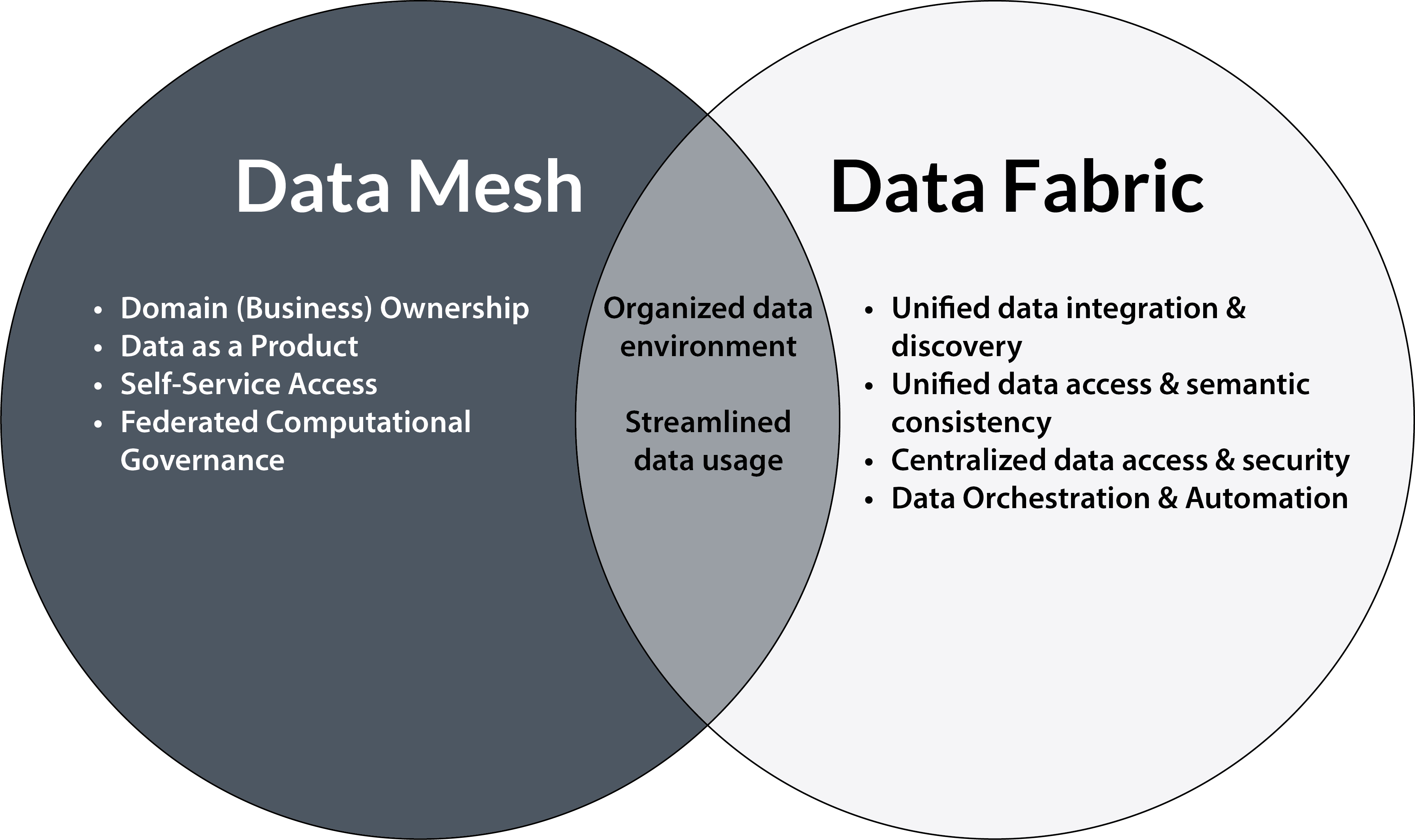
Underneath this reimagined UX are a set of logical, technical, and administrative constructs that are based on modern data architecture principles — most notably those introduced within the data mesh and data fabric approaches. With Fabric, you can adopt either approach or mix-and-match features to come up with an approach that works best for your business (see Figure 1).

Using Figure 1 as a reference, we’re going to unpack some of these key principles and see how they can be used to build and nurture a data culture within your business.
Business (Domain) Ownership
Within the data mesh approach, one of the four key principles is to shift data ownership back to the people that are closest to the data. The term “domain” in domain ownership refers to a business domain. In other words, we’re talking about the business units or departments that create and manage the data being produced in the first place. While this concept may feel foreign at first from a technical perspective, the reality is that no one understands the true value of data better than the business users that produce and use it every day.
It’s important to note that we’re only talking about transferring ownership of the data to a product owner/steward that best understands how to drive value from the data. This shift is not about locking the IT data team out of the data sets or trying to start some kind self-service data revolt.
Rather, it’s a shift towards the way most teams operate for all of their other development processes. Here, data mesh takes a page out of the Scrum agile playbook and (re)introduces product owners into the mix with data product development. As you can see in Figure 2, the product owner helps set the vision and coordinates the delivery of data products between multi-disciplinary teams.

With Fabric, you can establish these types of boundaries using domains. Here, for example, you might set up domains for each business unit/department within your business: sales, finance, marketing, HR, and so forth. Within each domain, you can:
- Assign dedicated administrators
- Control and secure access to domain-level resources
- Configure domain-specific overrides of tenant-wide settings
- Align with department-managed capacity units to manage costs/chargebacks separately
Data as a Product
Whenever we talk to customers about where they are with their data strategy, there’s always a lot of talk about “data assets”. Whether we’re talking about legacy enterprise data warehouses or modern data lakes, there’s always plenty of data assets lying around. However, when the conversation turns to the usage of these data assets, most customers admit that they’re not deriving very many insights from their data assets.
Within the data mesh approach, another core principle is the treatment of data as a product. In her seminal book on the topic, Data Mesh, Zhamak Dehghani points out that “Operational teams still perceive their data as a byproduct of running the business, leaving it to someone else, e.g., the data team to pick it up and recycle it into products. In contrast, data mesh domain teams apply product thinking with similar rigor to their data, striving for the best user experience.”
By applying product thinking to domain-oriented data, we’re able to transform many of those “throw-away” data assets into reusable data products that are both trustworthy and user-friendly to consumers. Within Fabric, product owners can promote these data products for widespread use across the organization. Using the OneLake Data Hub view shown in Figure 3 below, users can filter by domain and search for endorsed data products with ease. This takes a lot of the guesswork out of scanning through data artifacts to find the right one(s) to leverage for new projects.

Fabric as a Self-Serve Data Platform
To make a data mesh architecture work, you need a self-serve data platform that makes it easy to “…scale out sharing, accessing, and using analytical data in a decentralized manner” (Dehghani, 2022). Again, this is not about pushing pre-existing IT-based data teams out of the way. Instead, the goal is to stretch the reach of data products and empower a new population of generalist technologists to put these products to work across the enterprise.
As an all-in-one platform, Fabric really is the ideal self-serve data platform. As individual business units develop and certify their data products, consumers of varying types and backgrounds can easily search through Fabric and Microsoft Purview to find the relevant data products they need to be successful.
Figure 4 illustrates how all this comes together within Fabric. First, data products are organized into workspaces in OneLake. Then, using domains, we can group related workspaces by business unit and assign product owners/admins by department. Where necessary, data products can also be shared between domains using shortcuts.

As we observed in the previous section, consumers can easily search for endorsed data products within the Fabric UX. Then, they can right-click on an object and jump right into their preferred tool(s) to start drawing insights from that data (see Figure 5).

Unified Data Access & Discovery
As noted in the previous section, Fabric integrates seamlessly with Microsoft Purview. Here, one of the notable integration points is with the Purview data catalog. As data products are developed within Fabric, the modeling details can be loaded automatically into Purview. This enables consumers to browse through the Purview Data Catalog to discover data assets and bootstrap new data projects. This is way better than going on a scavenger hunt in search of a hidden database that’s rumored to exist out in the wild.

Empowering Generalist Technologists
When evaluating Fabric, we find that many of our customers are surprised to learn that it supports many low-code tools geared towards generalist technologists. Whether you’re a business analyst wanting to build a series of reports in Power BI or a citizen data scientist wanting to deeply analyze data, Fabric offers a wide variety of tools that meet developers of all types where they are:
- Power Query: Power Query is a graphical tool that can be used to build data transformations (think ETL). Using Power Query, you can build complex data transformation and enrichment solutions without having to write a single line of code.
- Power BI: Power BI makes it easy to create reports, dashboards, and even paginated reports using drag-and-drop designer tools.
- Data Wrangler: Data Wrangler is a powerful tool that citizen data scientists can use to cleanse and prepare data for various machine learning exercises. As you can see in Figure 7 below, Data Wrangler translates the operations you configure into working Python code behind the scenes.
- Copilot: With the Microsoft Copilot, you can get help writing SQL, DAX, and even PySpark/Python code within notebooks.

Centralized + Federated Computational Governance
From a security and governance perspective, Fabric is complemented by Microsoft Purview and other Azure-based security services like Entra ID. Collectively, these services help you define those cross-cutting governance and security policies that ensure that the mesh of independent data products remains secure.
From an organizational perspective, you have several options to control access to data products. Whether you go with centralized, decentralized, or hybrid access management approach is a really up to you.
In a way, you can think of these capabilities as the guardrails that ensure that decentralized data product teams are remaining compliant with enterprise-wide standards and processes. This system of checks and balances helps to manage risk and ensure compliance with regulatory standards.
Closing Thoughts
We hope this blog post helped you to see some of the powerful capabilities that Fabric unlocks within an organization. Collectively, these capabilities make it possible to completely reimagine the way that data products are built and distributed throughout the enterprise.
Although there’s no one-size-fits-all strategy that works for every business, the great thing about Fabric is that you have tremendous choice when it comes to defining your data culture. If you want to keep with the status quo in maintaining a centralized data warehouse, you can. Or, if you want to dip a toe in the data mesh or data fabric waters, you can do that too.
While it’s impossible to do all these features justice in such a limited space, we hope that this glimpse into some core Fabric capabilities has inspired you to think about what your future state data platform might look like. If you’re looking to get more mileage out of your data, then I would strongly encourage you to consider whether your existing platform provides the flexibility you need to be successful.
As always, we welcome your feedback and are happy to answer any questions you may have.